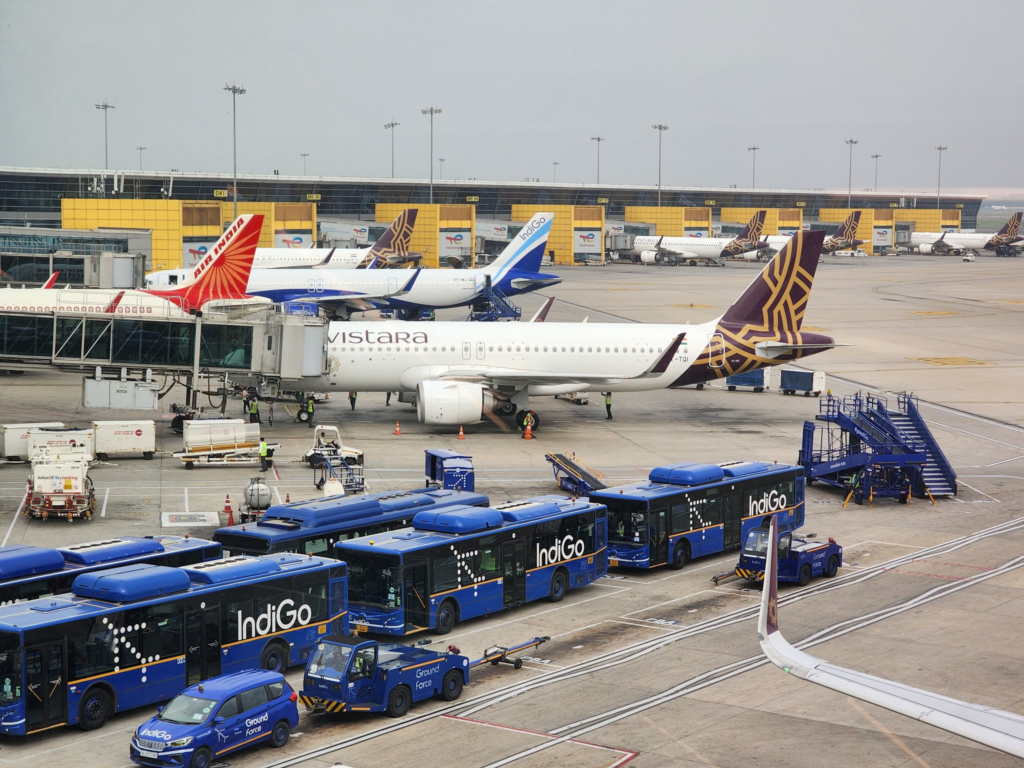
NEW DELHI— A full emergency was declared at Indira Gandhi International Airport (DEL) on Saturday morning after IndiGo Airlines (6E) flight 6E579, operating from Visakhapatnam (VTZ) to Delhi, reported a suspected engine failure mid-flight. Airport authorities activated emergency protocols immediately, and the aircraft landed safely without any injuries.
The Boeing 737, carrying 160 passengers, touched down at DEL at 10:59 AM IST. Runway 28 of the airport was placed on high alert as airport authorities quickly activated emergency protocols, and all passengers were safely evacuated after landing.

IndiGo Flight 6E579 Emergency Landing
A full emergency was declared at Indira Gandhi International Airport at 10:39 AM for IndiGo (6E) Visakhapatnam (VTZ)-Delhi (DEL) flight 6E 579 due to one engine failure.
The Civil Aviation Ministry confirmed the declaration while noting that overall airport operations remained normal throughout the incident.
The Delhi Fire Service received an alert at 10:53 AM and responded promptly. An emergency landing was made at IGI Airport, and the Fire Department confirmed the aircraft had landed.
According to flight tracking data from Flightradar24, the aircraft touched down at 10:59 AM, just 20 minutes after the emergency was first declared.
A full-scale emergency was declared on Runway 28 at 10:53 AM, and fire tenders rushed to the spot. Officials confirmed the aircraft landed safely, with all passengers and crew unharmed and no damage reported.
The flight 6E579 was operated by a Boeing 737-800 aircraft taken on lease from Corendon Airlines (XC) and is registered as TC-CON. Further, it is a 15.1-year-old aircraft powered by two CFM56-7B engines.
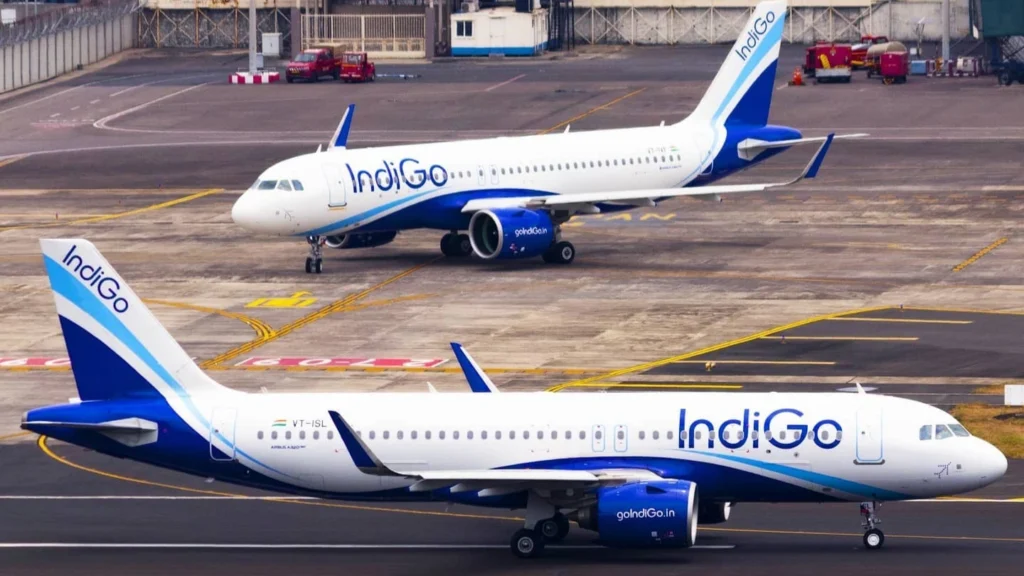
IndiGo’s Official Statement on the Incident
IndiGo stated that a technical snag was detected shortly before landing on flight 6E 579 operating from Visakhapatnam to Delhi on 28 March 2026.
As a precautionary step and in accordance with standard operating procedure, the pilots requested priority landing, and the aircraft arrived safely at Indira Gandhi International Airport, Delhi.
All relevant authorities were promptly informed, and the aircraft underwent necessary checks and maintenance.
The airline reaffirmed that passenger and crew safety remains its top priority, adding that the response followed established aviation safety procedures without deviation.
Similar Incident
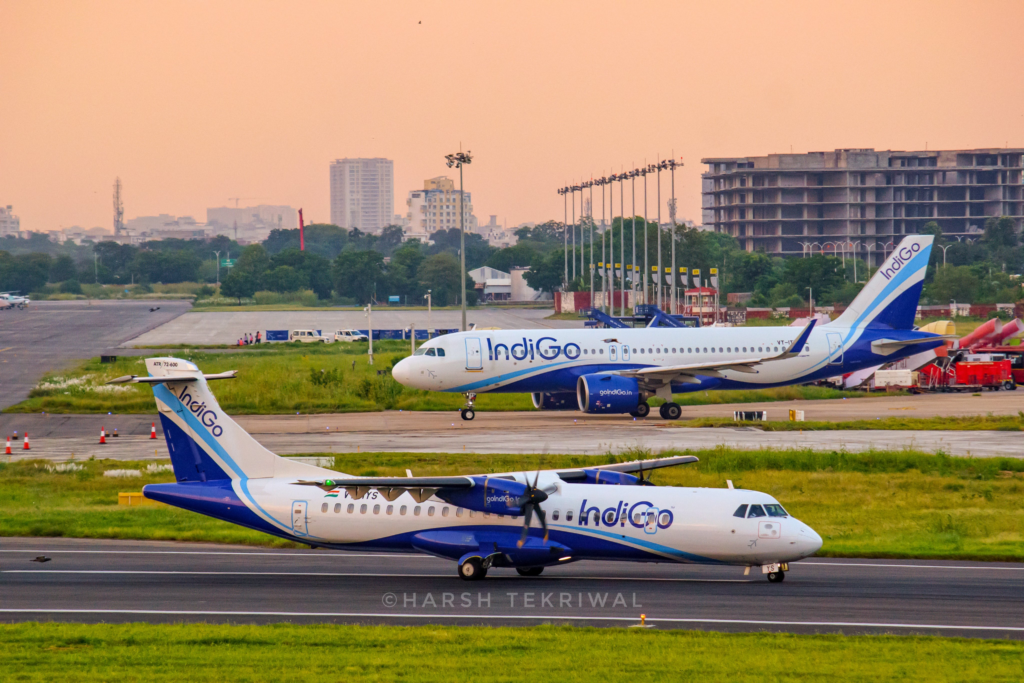
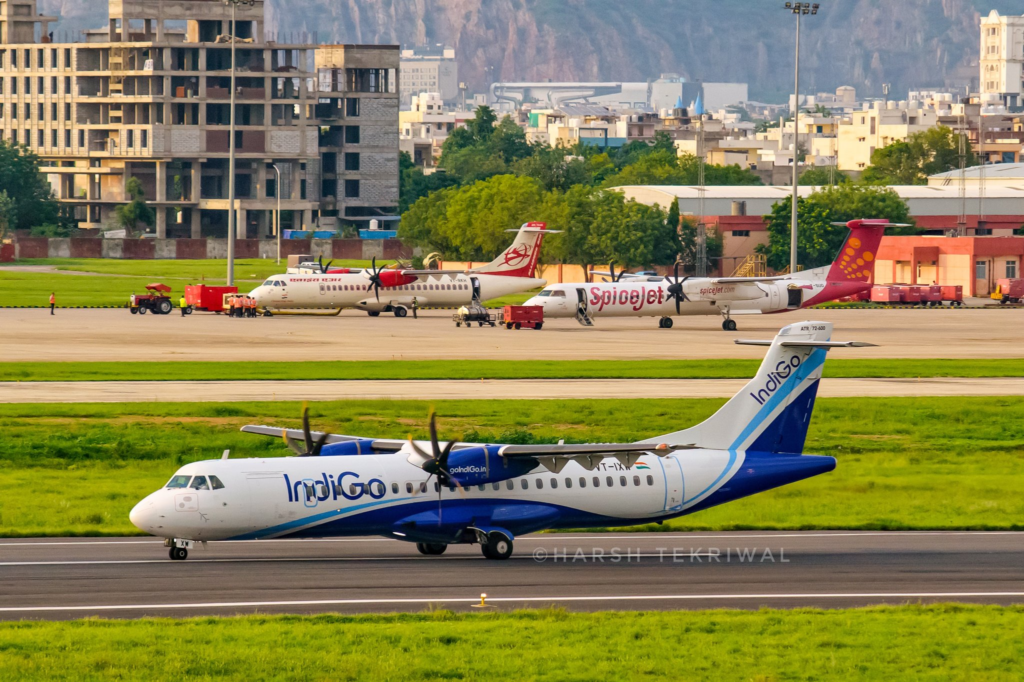
On May 2, 2025, IndiGo (6E) reported a rare in-flight technical event on a Jaipur (JAI) to Chandigarh (IXC) service involving a twin-engine flameout sequence. Both engines restarted automatically, and the aircraft landed safely.
The ATR turboprop encountered intense rainfall during the incident. Regulatory authorities have initiated an investigation, while the aircraft remains grounded in Chandigarh (IXC) for inspection.
Rare Dual Engine Flameout on IndiGo ATR Flight
The IndiGo ATR aircraft experienced a sequential flameout of both engines during a scheduled morning flight.
The first engine lost combustion briefly before the aircraft’s automatic ignition system restored power within seconds. Shortly after recovery, the second engine went through a similar flameout and restart cycle.
Aviation specialists consider this event highly unusual. Dual engine failures are extremely rare, and the fact that the engines failed one after the other, rather than simultaneously, reduced the severity of the situation. A simultaneous flameout could have significantly increased operational risk.
The aircraft continued normal operations after both engines recovered and completed the flight safely to Chandigarh.
Weather Conditions and Technical Response
The incident occurred during heavy rainfall across the region. According to regulatory officials, weather conditions likely affected engine performance parameters such as RPM and propeller speed.
IndiGo stated that a temporary drop in engine performance caused a reduction in combustion stability. The onboard engine control systems detected the anomaly and triggered automatic relight procedures, restoring normal function without manual intervention.
This type of automated recovery is a standard safety feature in modern turboprop engines and is designed to respond quickly to transient performance disruptions.
Stay tuned with us. Further, follow us on social media for the latest updates.
Join us on Telegram Group for the Latest Aviation Updates. Subsequently, follow us on Google News